

A One-way Data Table Summarizes
Two-fashion data compared to i-way data
Representing two-fashion data in charts and tables
Remember that ane-way data wasvariable information given forindividuals. For example, people and their heights, or water ice cream flavors and the number of scoops of each sold.
In this section we're transitioning to talk about ii-mode data, which is data which is dependent on more than one affair.

Hi! I'm krista.
I create online courses to assistance you stone your math class. Read more.
Sometimes we talk about two-manner data in terms ofindependent variables anddependent variables.
In the instance of i-way information, we had one independent variable, called the individuals, and ane or more than dependent variables, called the variables. In the case of two-way data, we have two contained categories on which the variables are dependent.
The difference between i-mode data and two-information is easiest to visualize by comparing a data table for each 1.
Ii-style tables
For example, let'south say that an artist started a business organization selling his paintings at the get-go of 2014. By the terminate of 2017, he's been in business for iv years, and his business has grown every year. If we add upwardly the revenue earned all iv years in January, all four years in Feb, all 4 years in March, etc., nosotros could summarize his total earnings by month in aone-fashion table:
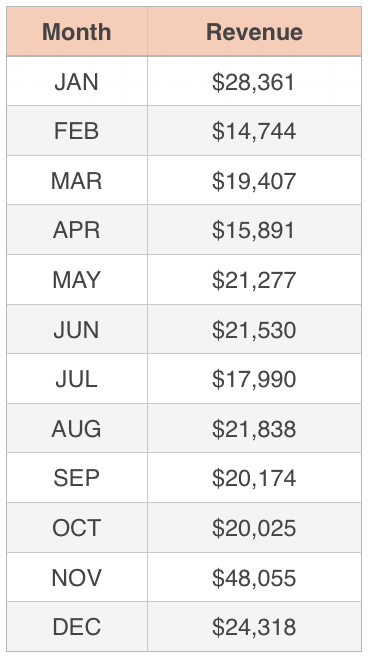
In this one-way tabular array, we have the months downwardly the left side. Those are the individuals (also called the independent variable). The acquirement is the variable (also called the dependent variable). In this chart, the revenue the artist earned from selling his paintings merely depends on one affair: the calendar month. We tin merely ask questions like "How much has the creative person earned in February?" or "How much has the creative person earned in September?"
Let's represent this as a bar graph.
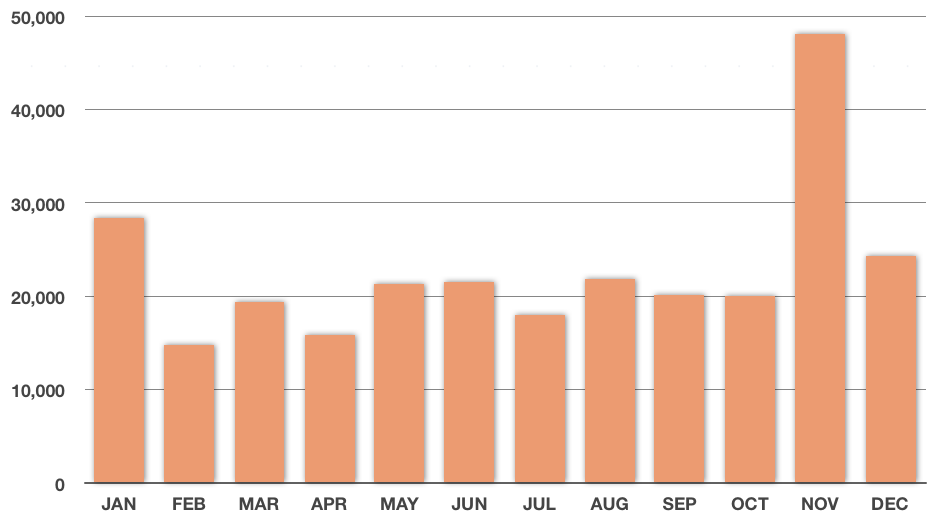
This certainly gives united states information most which months tend to be best for the creative person. November and January seem to be best. Merely since the data is summarized, calculation the revenue for January for all four years into one figure, and for February, for March, for Apr, etc., this 1-way data doesn't give usa any insight into how the creative person's business has grown over time.
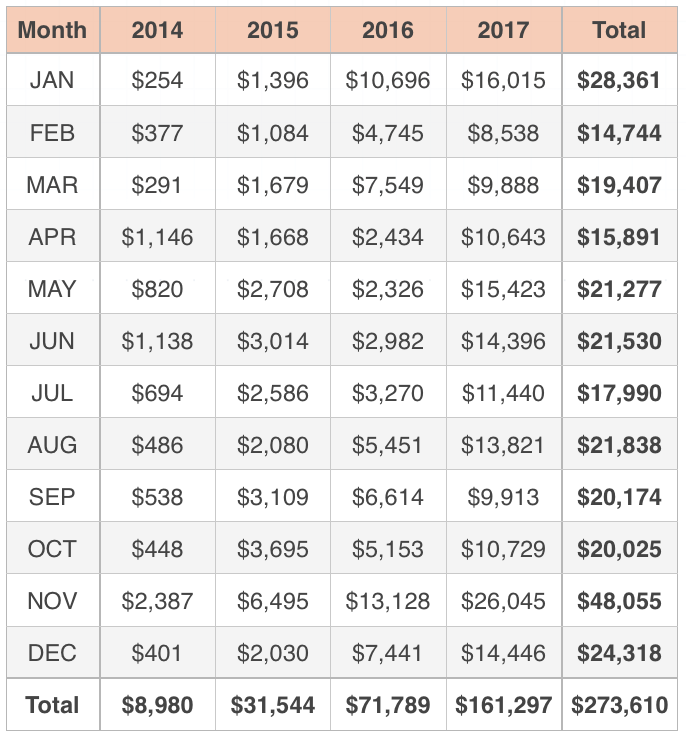
So to become more visibility, nosotros could instead pause autonomously the revenue information and testify each yr separately in atwo-way table:
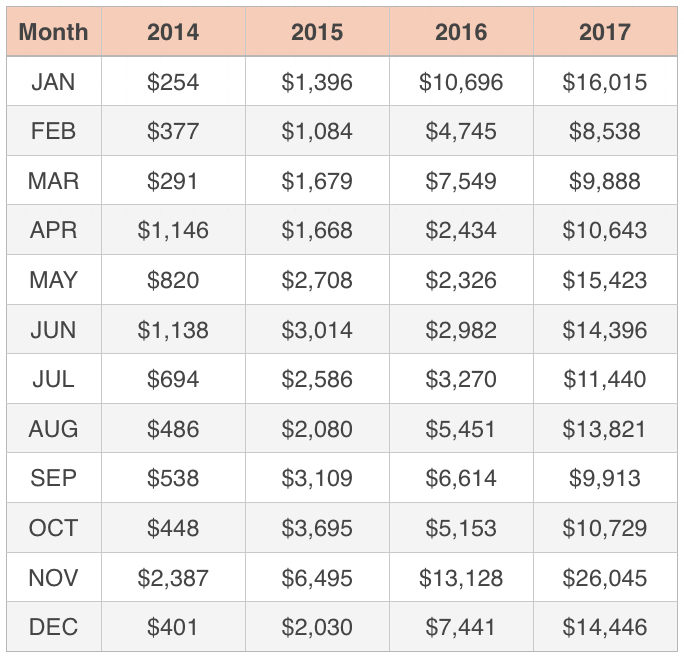
Notice how the data is the two-manner tabular array is at present dependent on two independent things, non just ane. In the one-mode table, if someone asked you how much revenue the artist earned, you'd respond "For which month?" But in the two-way table, if someone asked you how much revenue the creative person earned, you'd answer "For which year and for which month?" In the two-way table, each value depends on ii things: the calendar month and the year. Whereas in the ane-way table, each value depended on but on thing: the month.
We could graph the data in the two-way table in lots of unlike ways, but allow's do it every bit a line graph that starts in January, 2014 and ends in December, 2017.
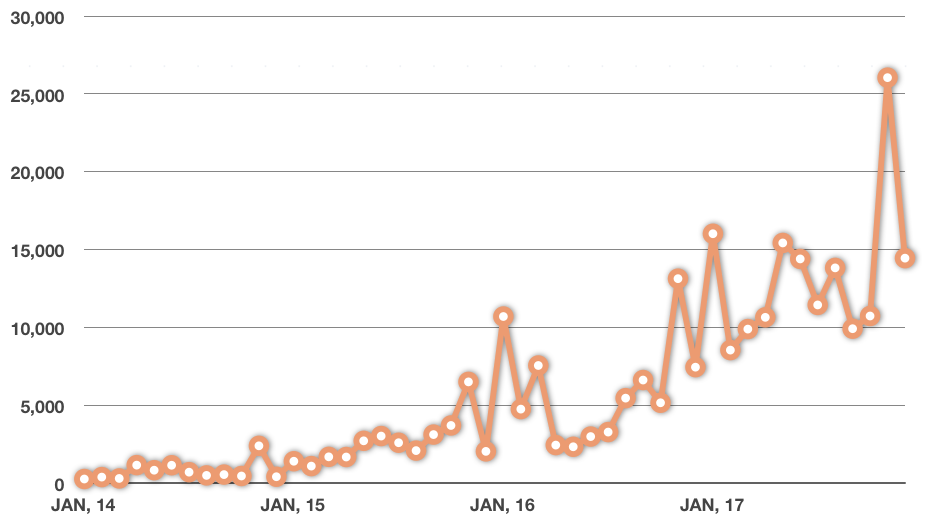
By giving the artist's revenue information in a 2-way table, we get so much more than insight into his business.
Showing totals
In ii-mode tables, nosotros can also summarize the data by row and by column, plus give a total for the unabridged table in the lower correct-manus corner.
The difference between one-way data and two-way information

Take the course
Want to acquire more nearly Probability & Statistics? I have a step-by-step class for that. :)
From the 2-fashion table, we can now run across the revenue totals for each calendar month down the correct side of the table (these lucifer the totals in the one-way tabular array), but we can as well see the revenue totals for each year along the bottom. We can still see which month is best for the artist (November), but we can as well see which year was all-time for the artist (2017).
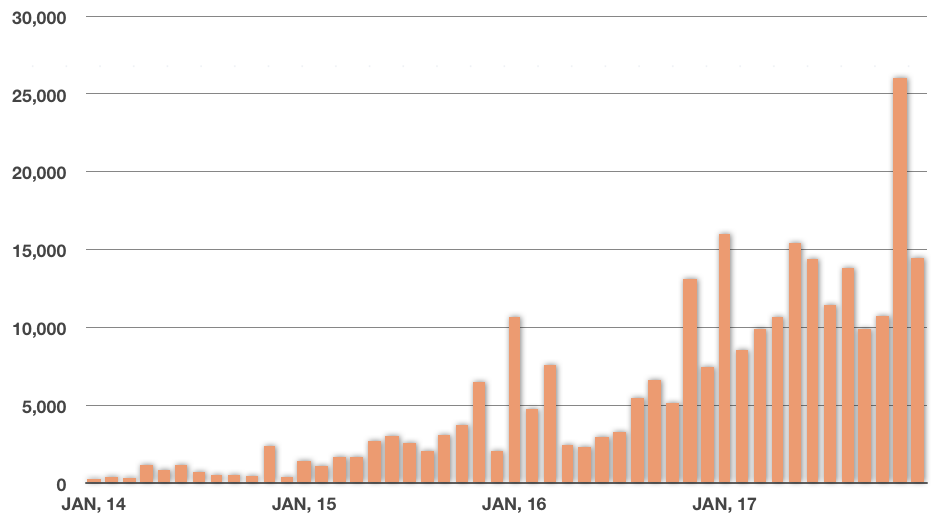
We did a line graph to represent all of this data over time, but we could have washed a bar graph, instead.

Sometimes we talk near 2-way data in terms of contained variables and dependent variables.
Nosotros could likewise create acomparison bar graph, illustrating the acquirement totals with side-by-side color coded bars for each year,
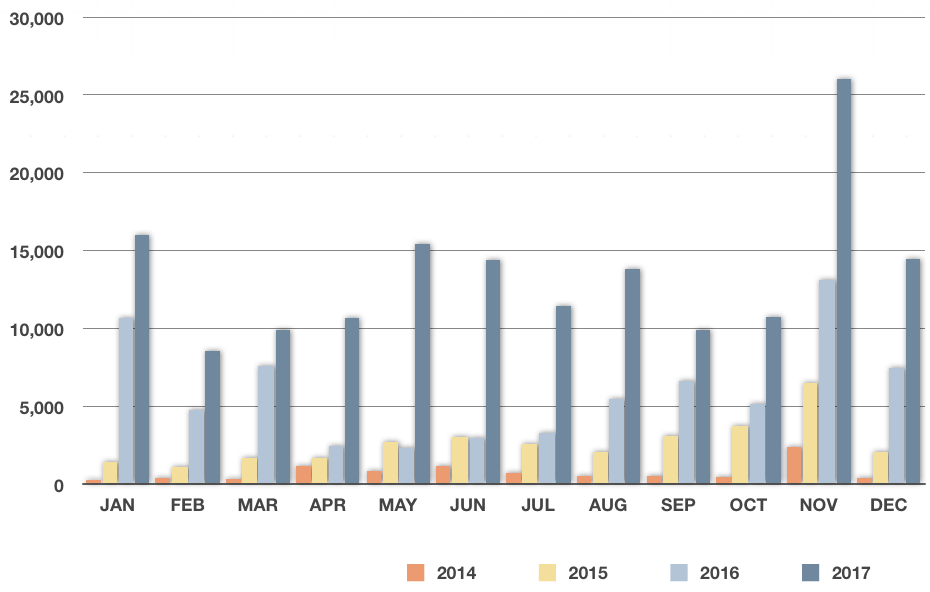
or acomparison line graph, depicting colour-coded line graphs for each year.
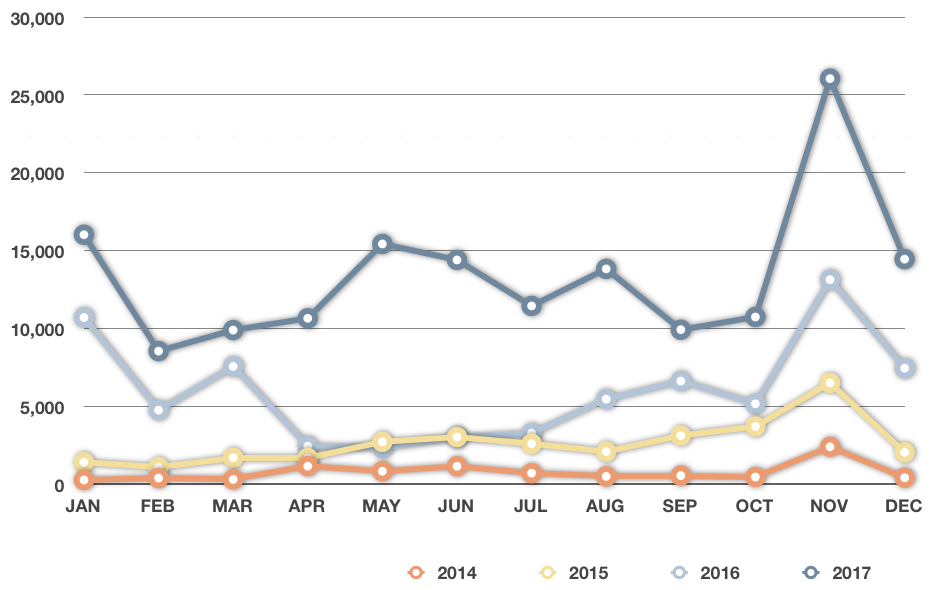

Get access to the complete Probability & Statistics form

A One-way Data Table Summarizes,
Source: https://www.kristakingmath.com/blog/two-way-data
Posted by: lunaupellift.blogspot.com
0 Response to "A One-way Data Table Summarizes"
Post a Comment