

Absolute Value Elasticity Of Demand
v.one The Toll Elasticity of Need
Learning Objectives
- Explain the concept of toll elasticity of demand and its calculation.
- Explain what it ways for demand to be price inelastic, unit price rubberband, cost elastic, perfectly toll inelastic, and perfectly price elastic.
- Explain how and why the value of the price elasticity of demand changes along a linear need curve.
- Understand the relationship betwixt full revenue and toll elasticity of demand.
- Discuss the determinants of toll elasticity of demand.
We know from the law of demand how the quantity demanded will respond to a price change: it will change in the opposite management. But how much will it change? It seems reasonable to expect, for example, that a 10% change in the price charged for a visit to the doctor would yield a unlike percentage change in quantity demanded than a ten% alter in the toll of a Ford Mustang. Simply how much is this difference?
To evidence how responsive quantity demanded is to a alter in price, we apply the concept of elasticity. The price elasticity of demand for a skillful or service, due east D, is the pct change in quantity demanded of a detail skilful or service divided by the percentage modify in the price of that good or service, all other things unchanged. Thus we can write
Equation 5.ii
[latex]e_D = \frac{\% \ change \ in \ quantity \ demanded}{\% \ change \ in \ price}[/latex]
Because the cost elasticity of demand shows the responsiveness of quantity demanded to a toll change, assuming that other factors that influence need are unchanged, it reflects movements along a need curve. With a downward-sloping demand bend, price and quantity demanded motility in opposite directions, and then the price elasticity of demand is always negative. A positive percentage alter in price implies a negative percentage change in quantity demanded, and vice versa. Sometimes you will see the absolute value of the price elasticity measure reported. In essence, the minus sign is ignored because information technology is expected that at that place will be a negative (inverse) relationship betwixt quantity demanded and price. In this text, however, nosotros will retain the minus sign in reporting price elasticity of need and volition say "the absolute value of the price elasticity of need" when that is what we are describing.
Heads Upwards!
Be conscientious not to confuse elasticity with slope. The slope of a line is the alter in the value of the variable on the vertical axis divided by the change in the value of the variable on the horizontal centrality between two points. Elasticity is the ratio of the pct changes. The gradient of a demand curve, for case, is the ratio of the alter in toll to the alter in quantity between two points on the curve. The cost elasticity of demand is the ratio of the percentage modify in quantity to the percentage change in toll. As we will meet, when computing elasticity at different points on a linear demand curve, the slope is abiding—that is, information technology does not modify—but the value for elasticity will alter.
Computing the Price Elasticity of Demand
Finding the price elasticity of demand requires that we first compute percent changes in toll and in quantity demanded. We summate those changes between two points on a demand bend.
Effigy 5.i "Responsiveness and Demand" shows a particular demand bend, a linear need curve for public transit rides. Suppose the initial cost is $0.80, and the quantity demanded is xl,000 rides per day; we are at indicate A on the curve. At present suppose the cost falls to $0.seventy, and nosotros want to report the responsiveness of the quantity demanded. We come across that at the new price, the quantity demanded rises to 60,000 rides per day (bespeak B). To compute the elasticity, we need to compute the percentage changes in price and in quantity demanded between points A and B.
Effigy 5.1 Responsiveness and Demand
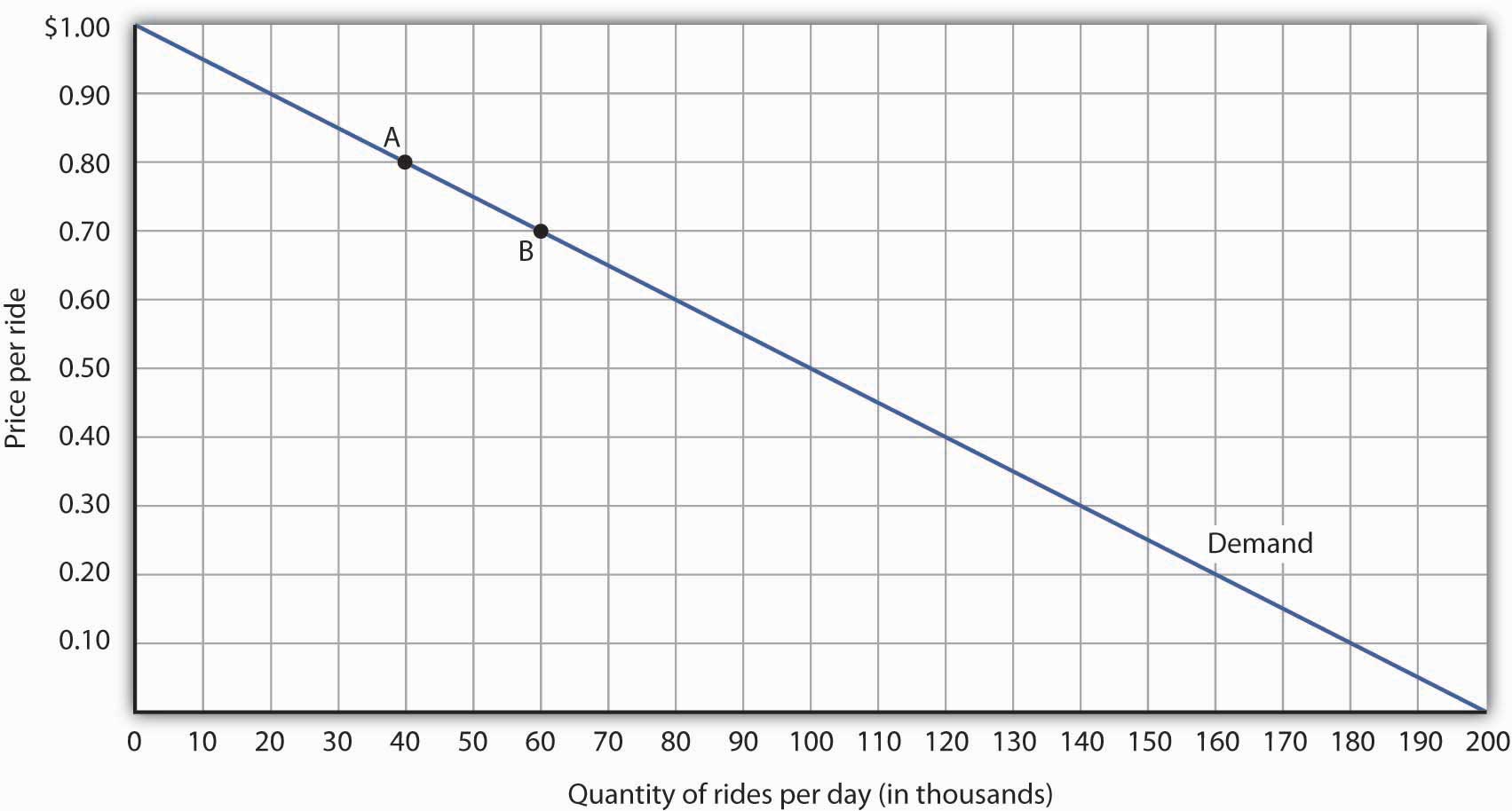
The demand bend shows how changes in toll lead to changes in the quantity demanded. A movement from point A to point B shows that a $0.10 reduction in price increases the number of rides per twenty-four hours by 20,000. A movement from B to A is a $0.x increment in toll, which reduces quantity demanded by 20,000 rides per 24-hour interval.
We mensurate the percentage alter between two points as the change in the variable divided by the average value of the variable betwixt the two points. Thus, the percent alter in quantity betwixt points A and B in Effigy 5.1 "Responsiveness and Demand" is computed relative to the average of the quantity values at points A and B: (threescore,000 + 40,000)/ii = 50,000. The per centum modify in quantity, so, is 20,000/50,000, or 40%. Likewise, the percentage change in toll between points A and B is based on the boilerplate of the two prices: ($0.lxxx + $0.lxx)/2 = $0.75, and so nosotros have a pct change of −0.10/0.75, or −xiii.33%. The toll elasticity of need betwixt points A and B is thus twoscore%/(−13.33%) = −3.00.
This mensurate of elasticity, which is based on percentage changes relative to the average value of each variable betwixt two points, is called arc elasticity. The arc elasticity method has the advantage that it yields the same elasticity whether we go from point A to point B or from betoken B to point A. It is the method nosotros shall use to compute elasticity.
For the arc elasticity method, we calculate the price elasticity of demand using the average value of price, $$ \bar{P} $$ , and the average value of quantity demanded, $$ \bar{Q} $$. We shall use the Greek letter Δ to mean "change in," and so the change in quantity betwixt ii points is ΔQ and the change in toll is ΔP. Now we can write the formula for the price elasticity of demand every bit
Equation 5.iii
[latex]\displaystyle e_D = \frac{\Delta Q / \bar{Q}}{\Delta P / \bar{P}}[/latex]
The price elasticity of demand between points A and B is thus:
[latex]e_D = \frac{\frac{20,000}{(40,000+60,000)/ii}}{\frac{- \$ 0.10}{( \$ 0.lxxx + \$ 0.70)/ii}} = \frac{40 \% }{-13.33 \% } = -iii.00[/latex]
With the arc elasticity formula, the elasticity is the same whether nosotros motility from point A to signal B or from point B to point A. If we start at indicate B and move to point A, nosotros have:
[latex]e_D = \frac{\frac{-xx,000}{(60,000+40,000)/2}}{\frac{ \$ 0.10}{( \$ 0.fourscore + \$ 0.70)/2}} = \frac{-40 \% }{thirteen.33 \% } = -iii.00[/latex]
The arc elasticity method gives united states an approximate of elasticity. It gives the value of elasticity at the midpoint over a range of change, such as the motion betwixt points A and B. For a precise computation of elasticity, nosotros would demand to consider the response of a dependent variable to an extremely small change in an independent variable. The fact that arc elasticities are estimate suggests an important practical rule in calculating arc elasticities: we should consider just minor changes in independent variables. We cannot utilise the concept of arc elasticity to big changes.
Another statement for considering only small changes in computing toll elasticities of demand will become evident in the next section. We will investigate what happens to price elasticities as we motion from one bespeak to some other along a linear need curve.
Heads Up!
Notice that in the arc elasticity formula, the method for computing a per centum modify differs from the standard method with which y'all may be familiar. That method measures the percentage alter in a variable relative to its original value. For example, using the standard method, when we go from point A to point B, we would compute the percentage change in quantity as 20,000/xl,000 = 50%. The pct change in price would exist −$0.10/$0.80 = −12.5%. The price elasticity of demand would then be 50%/(−12.5%) = −four.00. Going from point B to signal A, however, would yield a dissimilar elasticity. The percentage change in quantity would be −xx,000/lx,000, or −33.33%. The percentage modify in price would exist $0.ten/$0.70 = 14.29%. The price elasticity of need would thus exist −33.33%/xiv.29% = −2.33. By using the average quantity and average price to calculate per centum changes, the arc elasticity approach avoids the necessity to specify the direction of the change and, thereby, gives united states of america the same answer whether nosotros go from A to B or from B to A.
Toll Elasticities Along a Linear Demand Curve
What happens to the cost elasticity of demand when we travel along the demand curve? The answer depends on the nature of the demand curve itself. On a linear need curve, such as the one in Figure 5.2 "Cost Elasticities of Need for a Linear Demand Curve", elasticity becomes smaller (in absolute value) as we travel downward and to the right.
Figure 5.2 Price Elasticities of Demand for a Linear Need Bend
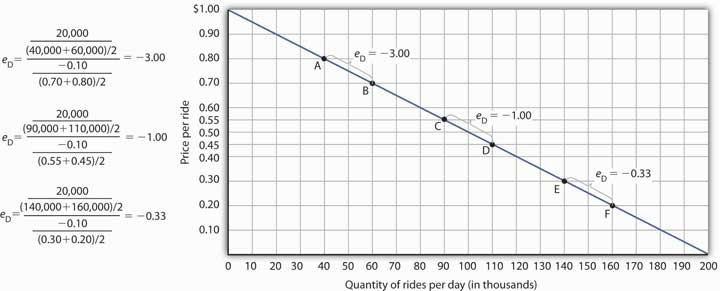
The price elasticity of demand varies between different pairs of points along a linear demand bend. The lower the price and the greater the quantity demanded, the lower the absolute value of the cost elasticity of need.
Figure 5.ii "Price Elasticities of Demand for a Linear Demand Curve" shows the same demand bend we saw in Effigy five.1 "Responsiveness and Need". We take already calculated the price elasticity of demand between points A and B; it equals −3.00. Notice, however, that when nosotros use the same method to compute the price elasticity of demand between other sets of points, our answer varies. For each of the pairs of points shown, the changes in price and quantity demanded are the same (a $0.10 decrease in price and 20,000 additional rides per day, respectively). But at the high prices and depression quantities on the upper part of the need bend, the percentage alter in quantity is relatively big, whereas the percentage change in price is relatively modest. The absolute value of the price elasticity of demand is thus relatively large. As nosotros motion downwards the demand curve, equal changes in quantity correspond smaller and smaller percent changes, whereas equal changes in cost stand for larger and larger percentage changes, and the absolute value of the elasticity measure out declines. Betwixt points C and D, for instance, the toll elasticity of need is −1.00, and betwixt points E and F the price elasticity of demand is −0.33.
On a linear demand bend, the toll elasticity of demand varies depending on the interval over which nosotros are measuring it. For whatever linear need bend, the absolute value of the cost elasticity of demand volition fall every bit we move down and to the right along the curve.
The Price Elasticity of Need and Changes in Total Revenue
Suppose the public transit authority is considering raising fares. Will its total revenues become up or downwardly? Total acquirement is the price per unit times the number of units soldane. In this case, it is the fare times the number of riders. The transit authority volition certainly want to know whether a price increase will crusade its total revenue to rise or fall. In fact, determining the impact of a price modify on total acquirement is crucial to the assay of many problems in economics.
We will do two quick calculations before generalizing the principle involved. Given the demand bend shown in Effigy 5.2 "Toll Elasticities of Need for a Linear Need Curve", we see that at a toll of $0.80, the transit say-so will sell forty,000 rides per day. Full acquirement would be $32,000 per mean solar day ($0.eighty times 40,000). If the toll were lowered by $0.10 to $0.70, quantity demanded would increase to 60,000 rides and full acquirement would increment to $42,000 ($0.70 times 60,000). The reduction in fare increases total revenue. However, if the initial toll had been $0.30 and the transit authority reduced information technology past $0.ten to $0.20, full acquirement would decrease from $42,000 ($0.30 times 140,000) to $32,000 ($0.20 times 160,000). And then it appears that the affect of a price change on total revenue depends on the initial price and, by implication, the original elasticity. We generalize this point in the remainder of this section.
The problem in assessing the impact of a toll change on full acquirement of a good or service is that a change in price always changes the quantity demanded in the opposite direction. An increase in price reduces the quantity demanded, and a reduction in cost increases the quantity demanded. The question is how much. Because total revenue is found by multiplying the price per unit times the quantity demanded, information technology is not clear whether a change in price will cause full revenue to rise or fall.
We have already made this bespeak in the context of the transit authorization. Consider the post-obit three examples of cost increases for gasoline, pizza, and nutrition cola.
Suppose that one,000 gallons of gasoline per day are demanded at a price of $4.00 per gallon. Total revenue for gasoline thus equals $4,000 per day (=one,000 gallons per day times $four.00 per gallon). If an increment in the cost of gasoline to $4.25 reduces the quantity demanded to 950 gallons per day, total revenue rises to $4,037.50 per day (=950 gallons per solar day times $4.25 per gallon). Even though people consume less gasoline at $iv.25 than at $four.00, total acquirement rises considering the higher price more than than makes upwards for the drop in consumption.
Side by side consider pizza. Suppose 1,000 pizzas per calendar week are demanded at a price of $9 per pizza. Full revenue for pizza equals $nine,000 per calendar week (=1,000 pizzas per week times $nine per pizza). If an increase in the price of pizza to $10 per pizza reduces quantity demanded to 900 pizzas per week, total revenue will still be $9,000 per week (=900 pizzas per week times $10 per pizza). Over again, when price goes up, consumers buy less, merely this time there is no change in total acquirement.
Now consider diet cola. Suppose 1,000 cans of nutrition cola per 24-hour interval are demanded at a price of $0.50 per can. Total revenue for diet cola equals $500 per day (=i,000 cans per day times $0.fifty per can). If an increase in the price of nutrition cola to $0.55 per can reduces quantity demanded to 880 cans per month, full revenue for diet cola falls to $484 per solar day (=880 cans per mean solar day times $0.55 per can). As in the case of gasoline, people will buy less diet cola when the price rises from $0.50 to $0.55, simply in this example total revenue drops.
In our first example, an increase in price increased total revenue. In the second, a price increase left total revenue unchanged. In the 3rd instance, the price rise reduced full revenue. Is at that place a way to predict how a price change volition touch full revenue? There is; the consequence depends on the price elasticity of demand.
Elastic, Unit Rubberband, and Inelastic Need
To determine how a toll alter will touch on total acquirement, economists identify price elasticities of demand in three categories, based on their absolute value. If the accented value of the cost elasticity of demand is greater than ane, demand is termed price elastic. If it is equal to 1, demand is unit cost rubberband. And if information technology is less than 1, demand is cost inelastic.
Relating Elasticity to Changes in Full Revenue
When the price of a skillful or service changes, the quantity demanded changes in the opposite management. Full acquirement will movement in the direction of the variable that changes by the larger percentage. If the variables move by the same percentage, total revenue stays the aforementioned. If quantity demanded changes by a larger pct than price (i.e., if need is cost rubberband), total acquirement will change in the direction of the quantity modify. If price changes by a larger percentage than quantity demanded (i.due east., if need is cost inelastic), total revenue will motion in the management of the price change. If cost and quantity demanded alter past the aforementioned per centum (i.e., if demand is unit cost elastic), and then total revenue does non modify.
When demand is toll inelastic, a given percentage change in price results in a smaller percentage change in quantity demanded. That implies that full revenue will motility in the direction of the price change: a reduction in price will reduce total acquirement, and an increase in price will increase it.
Consider the price elasticity of need for gasoline. In the instance higher up, ane,000 gallons of gasoline were purchased each day at a price of $iv.00 per gallon; an increment in price to $iv.25 per gallon reduced the quantity demanded to 950 gallons per day. We thus had an average quantity of 975 gallons per day and an average toll of $four.125. We can thus summate the arc toll elasticity of need for gasoline:
| Percentage alter in quantity demanded = -fifty/975 = -v.i% |
| Per centum change in price=0.25/4.125=six.06% |
| Cost elasticity of demand = -5.1%/6.06% = -.084 |
The demand for gasoline is price inelastic, and total acquirement moves in the direction of the cost change. When cost rises, total revenue rises. Recall that in our case to a higher place, full spending on gasoline (which equals total revenues to sellers) rose from $iv,000 per twenty-four hour period (=one,000 gallons per day times $4.00) to $4037.fifty per day (=950 gallons per twenty-four hour period times $4.25 per gallon).
When demand is price inelastic, a given percentage change in price results in a smaller percent modify in quantity demanded. That implies that full revenue will motion in the direction of the toll change: an increment in price will increase total acquirement, and a reduction in price volition reduce information technology.
Consider again the case of pizza that we examined above. At a price of $9 per pizza, ane,000 pizzas per week were demanded. Total revenue was $9,000 per week (=1,000 pizzas per calendar week times $9 per pizza). When the toll rose to $10, the quantity demanded vicious to 900 pizzas per calendar week. Total revenue remained $9,000 per calendar week (=900 pizzas per week times $10 per pizza). Once more, we take an average quantity of 950 pizzas per week and an average price of $9.l. Using the arc elasticity method, we tin compute:
| Percent change in quantity demanded = -100/950 = -ten.5% |
| Percent alter in price = $ane.00/$nine.50 = 10.5% |
| Cost elasticity of demand = -10.5%/x.5% = -1.0 |
Demand is unit price elastic, and total revenue remains unchanged. Quantity demanded falls by the same percent by which cost increases.
Consider next the example of diet cola demand. At a cost of $0.50 per can, 1,000 cans of diet cola were purchased each day. Total revenue was thus $500 per day (=$0.fifty per can times 1,000 cans per 24-hour interval). An increment in toll to $0.55 reduced the quantity demanded to 880 cans per day. We thus have an average quantity of 940 cans per day and an average cost of $0.525 per can. Computing the toll elasticity of need for nutrition cola in this example, we have:
| Percentage change in quantity demanded = -120/940 = -12.8% |
| Percentage change in price = $0.05/$0.525 = nine.5% |
| Price elasticity of demand = -12.eight%/nine.5% = -1.3 |
The demand for nutrition cola is price elastic, so total revenue moves in the direction of the quantity modify. It falls from $500 per twenty-four hour period before the cost increase to $484 per twenty-four hours afterwards the price increase.
A need bend tin can also be used to show changes in total revenue. Figure five.3 "Changes in Total Revenue and a Linear Demand Curve" shows the need curve from Effigy five.1 "Responsiveness and Demand" and Figure 5.2 "Cost Elasticities of Demand for a Linear Demand Curve". At point A, total revenue from public transit rides is given by the area of a rectangle drawn with signal A in the upper right-hand corner and the origin in the lower left-manus corner. The pinnacle of the rectangle is cost; its width is quantity. Nosotros take already seen that full revenue at signal A is $32,000 ($0.80 × twoscore,000). When nosotros reduce the price and motility to point B, the rectangle showing full revenue becomes shorter and wider. Find that the area gained in moving to the rectangle at B is greater than the area lost; total revenue rises to $42,000 ($0.70 × threescore,000). Think from Figure 5.ii "Price Elasticities of Demand for a Linear Demand Curve" that demand is elastic between points A and B. In general, need is rubberband in the upper half of whatever linear demand curve, so total revenue moves in the direction of the quantity change.
Figure five.3 Changes in Total Revenue and a Linear Demand Bend
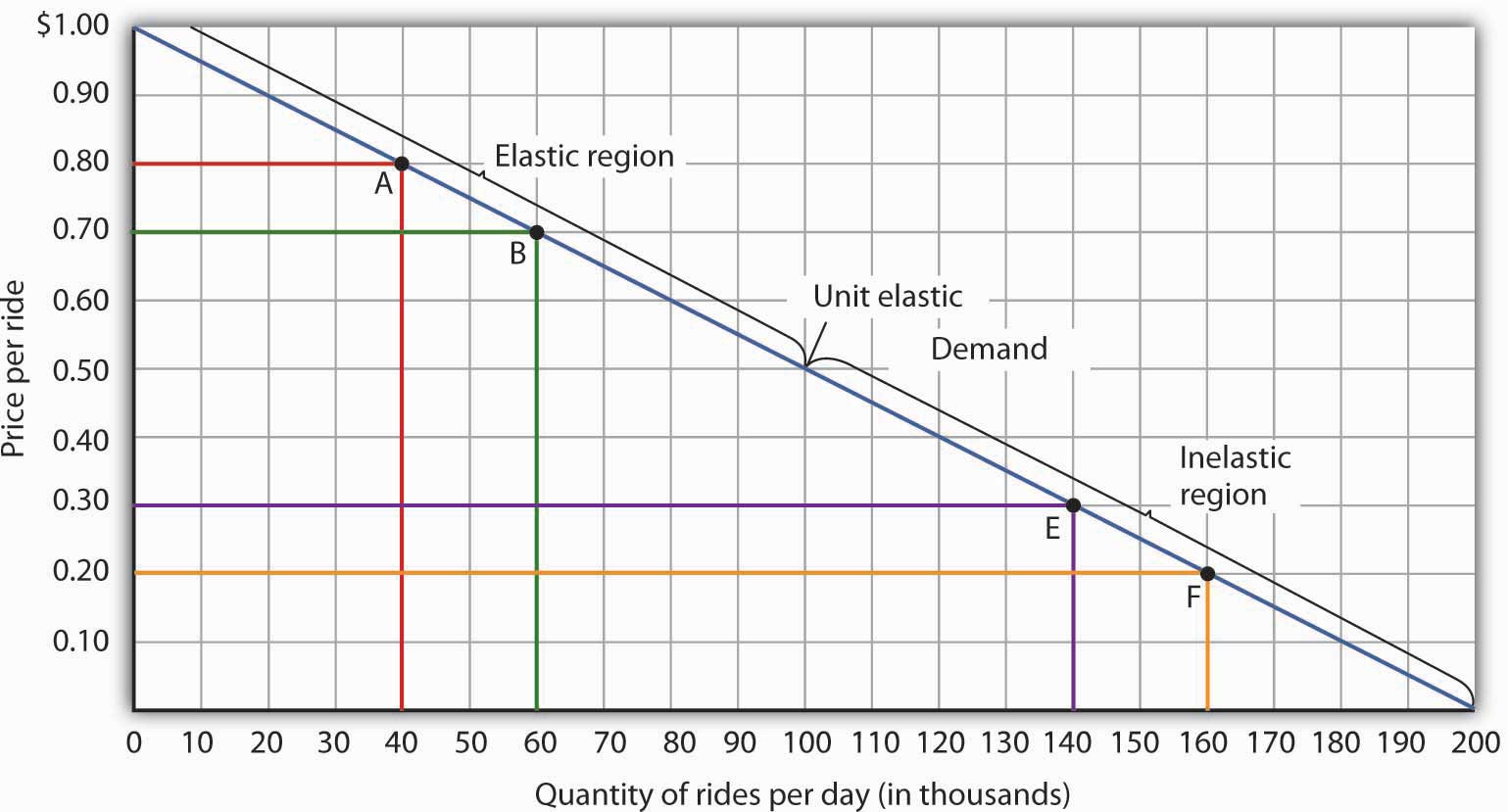
Moving from signal A to betoken B implies a reduction in toll and an increase in the quantity demanded. Demand is elastic between these two points. Full revenue, shown past the areas of the rectangles fatigued from points A and B to the origin, rises. When nosotros move from betoken Eastward to point F, which is in the inelastic region of the demand curve, total revenue falls.
A motion from point E to bespeak F also shows a reduction in cost and an increase in quantity demanded. This time, however, we are in an inelastic region of the demand curve. Full revenue at present moves in the direction of the price change—it falls. Notice that the rectangle drawn from point F is smaller in area than the rectangle drawn from point E, one time over again confirming our earlier calculation.
Effigy 5.4
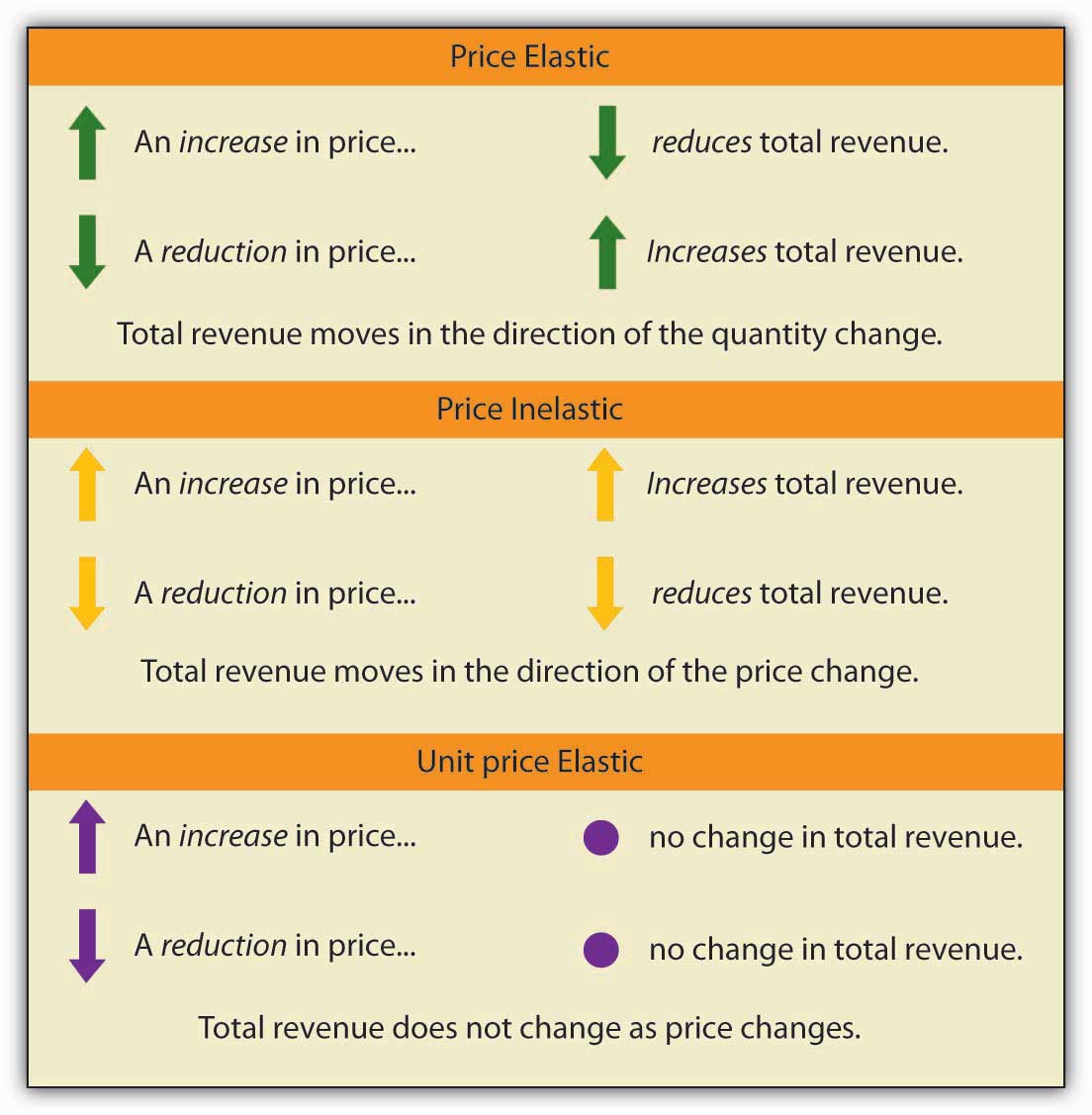
We have noted that a linear demand curve is more than rubberband where prices are relatively high and quantities relatively low and less rubberband where prices are relatively depression and quantities relatively high. We tin can be even more specific. For any linear demand curve, need will be cost rubberband in the upper one-half of the bend and price inelastic in its lower one-half. At the midpoint of a linear demand curve, demand is unit price rubberband.
Constant Price Elasticity of Need Curves
Figure 5.v "Demand Curves with Constant Price Elasticities" shows four need curves over which toll elasticity of need is the aforementioned at all points. The need bend in Console (a) is vertical. This means that toll changes have no result on quantity demanded. The numerator of the formula given in Equation 5.ii for the price elasticity of need (per centum alter in quantity demanded) is zero. The cost elasticity of need in this case is therefore zippo, and the need curve is said to be perfectly inelastic. This is a theoretically extreme example, and no good that has been studied empirically exactly fits information technology. A good that comes close, at least over a specific price range, is insulin. A diabetic volition not swallow more than insulin equally its toll falls only, over some price range, will consume the amount needed to control the disease.
Figure 5.5 Need Curves with Constant Price Elasticities
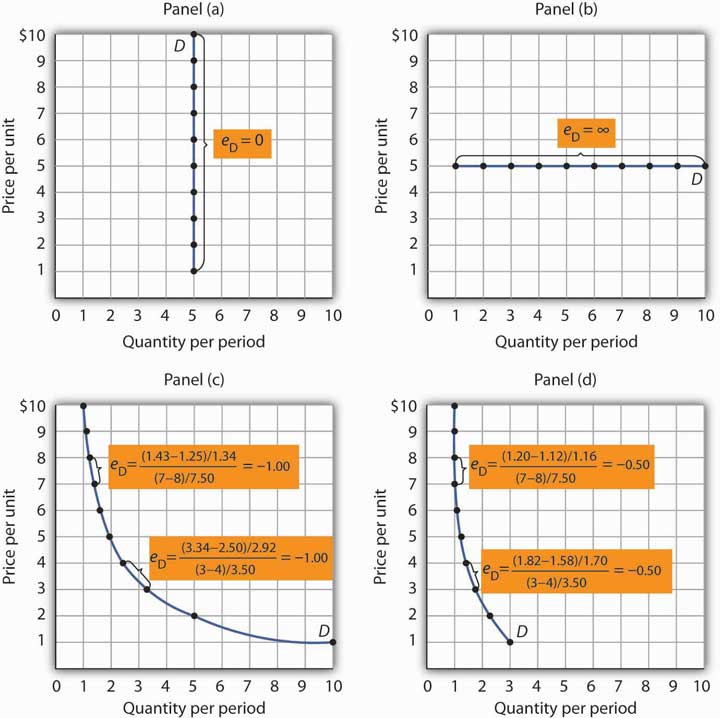
The demand curve in Panel (a) is perfectly inelastic. The need curve in Panel (b) is perfectly elastic. Price elasticity of need is −1.00 all along the demand curve in Panel (c), whereas information technology is −0.50 all along the demand bend in Console (d).
As illustrated in Figure 5.5 "Demand Curves with Constant Cost Elasticities", several other types of need curves have the same elasticity at every signal on them. The demand bend in Panel (b) is horizontal. This means that even the smallest price changes have enormous effects on quantity demanded. The denominator of the formula given in Equation 5.2 for the cost elasticity of demand (percentage change in price) approaches nothing. The price elasticity of need in this case is therefore infinite, and the demand curve is said to be perfectly elastic. This is the type of demand curve faced by producers of standardized products such every bit wheat. If the wheat of other farms is selling at $4 per bushel, a typical farm tin sell equally much wheat as it wants to at $four merely aught at a higher toll and would accept no reason to offer its wheat at a lower toll.
The nonlinear need curves in Panels (c) and (d) have price elasticities of demand that are negative; just, unlike the linear demand bend discussed above, the value of the price elasticity is constant all along each demand curve. The demand curve in Console (c) has price elasticity of demand equal to −ane.00 throughout its range; in Panel (d) the price elasticity of demand is equal to −0.l throughout its range. Empirical estimates of demand ofttimes bear witness curves like those in Panels (c) and (d) that have the same elasticity at every indicate on the curve.
Heads Upwardly!
Do not confuse cost inelastic demand and perfectly inelastic demand. Perfectly inelastic demand means that the change in quantity is naught for any pct change in price; the need curve in this case is vertical. Price inelastic need means only that the pct change in quantity is less than the percentage change in price, not that the change in quantity is zip. With price inelastic (as opposed to perfectly inelastic) demand, the demand bend itself is however down sloping.
Determinants of the Price Elasticity of Need
The greater the absolute value of the cost elasticity of demand, the greater the responsiveness of quantity demanded to a price change. What determines whether demand is more or less price elastic? The almost of import determinants of the price elasticity of demand for a expert or service are the availability of substitutes, the importance of the item in household budgets, and time.
Availability of Substitutes
The cost elasticity of demand for a practiced or service will exist greater in absolute value if many close substitutes are available for it. If there are lots of substitutes for a particular good or service, and then it is like shooting fish in a barrel for consumers to switch to those substitutes when in that location is a price increment for that skilful or service. Suppose, for instance, that the cost of Ford automobiles goes upwards. There are many close substitutes for Fords—Chevrolets, Chryslers, Toyotas, so on. The availability of close substitutes tends to brand the need for Fords more toll elastic.
If a good has no close substitutes, its demand is likely to be somewhat less price rubberband. There are no close substitutes for gasoline, for example. The price elasticity of demand for gasoline in the intermediate term of, say, three–nine months is generally estimated to be well-nigh −0.v. Since the absolute value of cost elasticity is less than 1, information technology is price inelastic. Nosotros would await, though, that the need for a detail brand of gasoline will exist much more than cost elastic than the demand for gasoline in general.
Importance in Household Budgets
Ane reason price changes affect quantity demanded is that they change how much a consumer can purchase; a change in the price of a expert or service affects the purchasing power of a consumer's income and thus affects the amount of a skilful the consumer will buy. This outcome is stronger when a good or service is of import in a typical household's budget.
A change in the toll of jeans, for example, is probably more of import in your budget than a modify in the price of pencils. Suppose the prices of both were to double. You had planned to buy four pairs of jeans this twelvemonth, merely now you lot might decide to make do with two new pairs. A change in pencil prices, in contrast, might lead to very fiddling reduction in quantity demanded simply because pencils are not likely to loom large in household budgets. The greater the importance of an item in household budgets, the greater the absolute value of the price elasticity of demand is likely to exist.
Fourth dimension
Suppose the price of electricity rises tomorrow morning. What will happen to the quantity demanded?
The answer depends in large part on how much fourth dimension we allow for a response. If we are interested in the reduction in quantity demanded by tomorrow afternoon, we tin can expect that the response will be very small. Merely if we give consumers a yr to respond to the price change, we can look the response to be much greater. We look that the absolute value of the price elasticity of demand will exist greater when more time is allowed for consumer responses.
Consider the toll elasticity of crude oil demand. Economist John C. B. Cooper estimated short- and long-run cost elasticities of demand for crude oil for 23 industrialized nations for the period 1971–2000. Professor Cooper constitute that for nearly every country, the toll elasticities were negative, and the long-run toll elasticities were generally much greater (in absolute value) than were the short-run toll elasticities. His results are reported in Table v.one "Brusque- and Long-Run Price Elasticities of the Need for Crude Oil in 23 Countries". As you can encounter, the research was reported in a periodical published by OPEC (Arrangement of Petroleum Exporting Countries), an organisation whose members have profited greatly from the inelasticity of demand for their product. By restricting supply, OPEC, which produces nigh 45% of the world's crude oil, is able to put upward force per unit area on the price of rough. That increases OPEC's (and all other oil producers') total revenues and reduces total costs.
Tabular array 5.1 Short- and Long-Run Price Elasticities of the Need for Crude Oil in 23 Countries
| Country | Curt-Run Price Elasticity of Demand | Long-Run Price Elasticity of Demand |
|---|---|---|
| Australia | −0.034 | −0.068 |
| Austria | −0.059 | −0.092 |
| Canada | −0.041 | −0.352 |
| China | 0.001 | 0.005 |
| Denmark | −0.026 | −0.191 |
| Finland | −0.016 | −0.033 |
| France | −0.069 | −0.568 |
| Frg | −0.024 | −0.279 |
| Greece | −0.055 | −0.126 |
| Iceland | −0.109 | −0.452 |
| Ireland | −0.082 | −0.196 |
| Italy | −0.035 | −0.208 |
| Japan | −0.071 | −0.357 |
| Korea | −0.094 | −0.178 |
| Netherlands | −0.057 | −0.244 |
| New Zealand | −0.054 | −0.326 |
| Kingdom of norway | −0.026 | −0.036 |
| Portugal | 0.023 | 0.038 |
| Spain | −0.087 | −0.146 |
| Sweden | −0.043 | −0.289 |
| Switzerland | −0.030 | −0.056 |
| United Kingdom | −0.068 | −0.182 |
| United States | −0.061 | −0.453 |
For most countries, toll elasticity of demand for crude oil tends to be greater (in absolute value) in the long run than in the short run.
Source: John C. B. Cooper, "Toll Elasticity of Need for Crude Oil: Estimates from 23 Countries," OPEC Review: Energy Economics & Related Bug, 27:1 (March 2003): four. The estimates are based on data for the catamenia 1971–2000, except for Mainland china and South korea, where the flow is 1979–2000. While the price elasticities for People's republic of china and Portugal were positive, they were not statistically significant.
Key Takeaways
- The price elasticity of need measures the responsiveness of quantity demanded to changes in price; it is calculated by dividing the percentage change in quantity demanded by the percentage modify in price.
- Demand is cost inelastic if the absolute value of the cost elasticity of demand is less than i; it is unit cost elastic if the absolute value is equal to 1; and it is toll elastic if the absolute value is greater than 1.
- Demand is price elastic in the upper half of any linear demand bend and price inelastic in the lower half. It is unit cost rubberband at the midpoint.
- When demand is price inelastic, full revenue moves in the management of a toll change. When demand is unit price rubberband, total revenue does not alter in response to a price change. When need is price elastic, total acquirement moves in the direction of a quantity change.
- The absolute value of the price elasticity of demand is greater when substitutes are available, when the good is important in household budgets, and when buyers have more time to accommodate to changes in the price of the good.
Endeavour Information technology!
You are now ready to play the office of the director of the public transit system. Your finance officeholder has but advised y'all that the organization faces a deficit. Your board does non want you to cut service, which ways that you cannot cut costs. Your only hope is to increase revenue. Would a fare increase heave revenue?
You consult the economist on your staff who has researched studies on public transportation elasticities. She reports that the estimated price elasticity of demand for the first few months after a toll alter is most −0.iii, only that subsequently several years, it volition be virtually −1.5.
- Explain why the estimated values for price elasticity of demand differ.
- Compute what volition happen to ridership and revenue over the adjacent few months if yous decide to heighten fares by 5%.
- Compute what will happen to ridership and revenue over the next few years if you lot make up one's mind to raise fares by v%.
- What happens to full acquirement now and later several years if yous choose to raise fares?
Case in Indicate: Elasticity and Stop Lights
Effigy v.half-dozen

We all face up the situation every day. You are approaching an intersection. The xanthous light comes on. You know that yous are supposed to tiresome down, but you are in a bit of a bustle. Then, you speed up a little to try to make the light. Only the ruby low-cal flashes on just before you get to the intersection. Should you lot gamble it and get through?
Many people faced with that situation accept the risky choice. In 1998, 2,000 people in the United States died as a result of drivers running cerise lights at intersections. In an effort to reduce the number of drivers who make such choices, many areas accept installed cameras at intersections. Drivers who run ruby-red lights accept their pictures taken and receive citations in the mail. This enforcement method, together with recent increases in the fines for driving through red lights at intersections, has led to an intriguing awarding of the concept of elasticity. Economists Avner Bar-Ilan of the University of Haifa in Israel and Bruce Sacerdote of Dartmouth University have estimated what is, in effect, the toll elasticity for driving through stoplights with respect to traffic fines at intersections in State of israel and in San Francisco.
In Dec 1996, Israel sharply increased the fine for driving through a cherry-red light. The old fine of 400 shekels (this was equal at that time to $122 in the United states of america) was increased to 1,000 shekels ($305). In Jan 1998, California raised its fine for the criminal offence from $104 to $271. The country of Israel and the city of San Francisco installed cameras at several intersections. Drivers who ignored stoplights got their pictures taken and automatically received citations imposing the new college fines.
We can think of driving through red lights as an activity for which there is a demand—later all, ignoring a red low-cal speeds up one'south trip. Information technology may also generate satisfaction to people who savor disobeying traffic laws. The concept of elasticity gives us a style to show only how responsive drivers were to the increase in fines.
Professors Bar-Ilan and Sacerdote obtained information on all the drivers cited at 73 intersections in Israel and eight intersections in San Francisco. For Israel, for example, they defined the period January 1992 to June 1996 as the "before" menstruum. They compared the number of violations during the earlier period to the number of violations from July 1996 to December 1999—the "subsequently" menstruum—and found there was a reduction in tickets per driver of 31.5 per cent. Specifically, the average number of tickets per commuter was 0.073 during the catamenia before the increase; it fell to 0.050 after the increment. The increase in the fine was 150 per cent. (Notation that, because they were making a "earlier" and "after" calculation, the authors used the standard method described in the Heads Up! on computing a percentage change—i.east., they computed the percentage changes in comparing to the original values instead of the average value of the variables.) The elasticity of citations with respect to the fine was thus −0.21 (= −31.v%/150%).
The economists estimated elasticities for particular groups of people. For case, young people (historic period 17–30) had an elasticity of −0.36; people over the age of 30 had an elasticity of −0.16. In general, elasticities fell in absolute value equally income rose. For San Francisco and Israel combined, the elasticity was between −0.26 and −0.33.
In general, the results showed that people responded rationally to the increases in fines. Increasing the cost of a detail behavior reduced the frequency of that beliefs. The report as well points out the effectiveness of cameras as an enforcement technique. With cameras, violators tin can be certain they will exist cited if they ignore a cherry-red light. And reducing the number of people running cherry lights clearly saves lives.
Source: Avner Bar-Ilan and Bruce Sacerdote. "The Response of Criminals and Non-Criminals to Fines." Journal of Law and Economics, 47:ane (Apr 2004): one–17.
Answers to Try It! Problems
- The absolute value of price elasticity of demand tends to be greater when more than time is allowed for consumers to answer. Over time, riders of the commuter runway arrangement can organize car pools, motility, or otherwise adjust to the fare increase.
- Using the formula for price elasticity of demand and plugging in values for the estimate of price elasticity (−0.five) and the percentage modify in toll (5%) and then rearranging terms, nosotros can solve for the pct change in quantity demanded every bit: e D = %Δ in Q/%Δ in P ; −0.5 = %Δ in Q/5% ; (−0.5)(five%) = %Δ in Q = −2.5%. Ridership falls past 2.5% in the commencement few months.
- Using the formula for price elasticity of demand and plugging in values for the approximate of price elasticity over a few years (−1.v) and the percentage change in price (v%), we can solve for the percentage change in quantity demanded equally east D = %Δ in Q/%Δ in P ; −i.five = %Δ in Q/5% ; (−1.5)(5%) = %Δ in Q = −7.5%. Ridership falls past 7.5% over a few years.
- Total revenue rises immediately after the fare increment, since demand over the immediate period is price inelastic. Total revenue falls after a few years, since need changes and becomes price elastic.
aneObserve that since the number of units sold of a good is the aforementioned equally the number of units bought, the definition for total acquirement could also be used to define total spending. Which term we use depends on the question at mitt. If we are trying to determine what happens to revenues of sellers, then we are asking well-nigh total revenue. If we are trying to determine how much consumers spend, and so we are asking about full spending.
2Division by aught results in an undefined solution. Saying that the toll elasticity of need is infinite requires that we say the denominator "approaches" nil.

Absolute Value Elasticity Of Demand,
Source: https://open.lib.umn.edu/principleseconomics/chapter/5-1-the-price-elasticity-of-demand/
Posted by: lunaupellift.blogspot.com
0 Response to "Absolute Value Elasticity Of Demand"
Post a Comment