

Example Of Intrinsic Value Ethics
Business is the practise of making ane's living or making coin by producing or buying and selling products (such equally goods and services).[i] [ii] [3] [4] It is also "any activeness or enterprise entered into for profit."[5]
Having a business name does not separate the business entity from the owner, which means that the possessor of the concern is responsible and liable for debts incurred by the concern. If the business acquires debts, the creditors tin go after the owner's personal possessions. A business organization structure does non let for corporate tax rates. The proprietor is personally taxed on all income from the business organization.
The term is also often used colloquially (but not by lawyers or by public officials) to refer to a company, such every bit a corporation or cooperative.
Corporations, in contrast with sole proprietors and partnerships, are a separate legal entity and provide limited liability for their owners/members, as well as being subject to corporate tax rates. A corporation is more complicated and expensive to prepare, merely offers more protection and benefits for the owners/members.
Forms
Forms of concern buying vary past jurisdiction, but several mutual entities exist:
- A sole proprietorship, also known as a sole trader, is owned by one person and operates for their benefit. The owner operates the business alone and may hire employees. A sole proprietor has unlimited liability for all obligations incurred by the business organisation, whether from operating costs or judgments against the business. All avails of the business belong to a sole proprietor, including, for example, a reckoner infrastructure, any inventory, manufacturing equipment, or retail fixtures, likewise as any real holding owned by the sole proprietor.
- A partnership is a business organization owned by two or more than people. In most forms of partnerships, each partner has unlimited liability for the debts incurred past the business organisation. The three most prevalent types of for-turn a profit partnerships are general partnerships, limited partnerships, and limited liability partnerships.[6]
- Corporations' owners have limited liability and the business has a carve up legal personality from its owners. Corporations can exist either authorities-endemic or privately owned, and they can organize either for profit or as nonprofit organizations. A privately owned, for-profit corporation is owned past its shareholders, who elect a lath of directors to direct the corporation and rent its managerial staff. A privately owned, for-profit corporation tin can be either privately held by a small group of individuals, or publicly held, with publicly traded shares listed on a stock substitution.
- A cooperative or co-op is a limited-liability business that can organize equally for-profit or non-for-profit. A cooperative differs from a corporation in that information technology has members, non shareholders, and they share controlling authority. Cooperatives are typically classified every bit either consumer cooperatives or worker cooperatives. Cooperatives are fundamental to the ideology of economic democracy.
- Express liability companies (LLC), and other specific types of business organization organization protect their owners or shareholders from business failure by doing business nether a separate legal entity with certain legal protections. In contrast, a general partnership or persons working on their own are usually not as protected.[7] [8]
- A franchise is a system in which entrepreneurs purchase the rights to open up and run a concern from a larger corporation.[9] Franchising in the The states is widespread and is a major economical powerhouse. One out of twelve retail businesses in the U.s. are franchised and eight 1000000 people are employed in a franchised business.[10]
- Company express by guarantee is Commonly used where companies are formed for not-commercial purposes, such as clubs or charities. The members guarantee the payment of sure (commonly nominal) amounts if the company goes into insolvent liquidation, but otherwise, they have no economic rights in relation to the company. This type of visitor is mutual in England. A visitor limited by guarantee may be with or without having share capital.
- A company limited by shares is the most common form of the company used for business organization ventures. Specifically, a limited company is a "company in which the liability of each shareholder is limited to the amount individually invested" with corporations existence "the well-nigh common example of a express visitor."[11] This type of company is common in England and many English language-speaking countries. A company limited by shares may be a
- publicly traded company or a
- privately held company
- A company limited past guarantee with a share capital letter: A hybrid entity, normally used where the company is formed for non-commercial purposes, but the activities of the company are partly funded by investors who expect a return. This blazon of company may no longer exist formed in the Great britain, although provisions still be in law for them to exist.[12]
- An unlimited company with or without a share capital: A hybrid entity, a company where the liability of members or shareholders for the debts (if whatever) of the company are not limited. In this case, the doctrine of a veil of incorporation does not apply.
Less mutual types of companies are:
- Most corporations by letters patent are corporations sole and non companies as the term is commonly understood today.
- Charter corporations these were the just types of companies before the passing of modernistic companies legislation. At present they are relatively rare, except for very quondam companies that still survive (of which there are nonetheless many, particularly many British banks), or modernistic societies that fulfill a quasi-regulatory function (for instance, the Bank of England is a corporation formed by a modern lease).
- Statutory companies: Relatively rare today, certain companies have been formed past a individual statute passed in the relevant jurisdiction.
Note that "Ltd later the company'due south proper name signifies express visitor, and PLC (public limited company) indicates that its shares are widely held."[13]
In legal parlance, the owners of a company are normally referred to every bit the "members". In a company express or unlimited by shares (formed or incorporated with a share capital), this will be the shareholders. In a company limited by guarantee, this will be the guarantors. Some offshore jurisdictions have created special forms of offshore company in a bid to attract business concern for their jurisdictions. Examples include "segregated portfolio companies" and restricted purpose companies.
There are, however, many, many sub-categories of types of company that tin can be formed in various jurisdictions in the world.
Companies are likewise sometimes distinguished into public companies and private companies for legal and regulatory purposes. Public companies are companies whose shares tin can be publicly traded, often (although not always) on a stock commutation which imposes listing requirements/Listing Rules as to the issued shares, the trading of shares and a future issue of shares to help bolster the reputation of the exchange or item marketplace of exchange. Private companies do non accept publicly traded shares, and frequently contain restrictions on transfers of shares. In some jurisdictions, private companies accept maximum numbers of shareholders.
A parent company is a company that owns enough voting stock in another firm to control management and operations by influencing or electing its board of directors; the second company being accounted as a subsidiary of the parent company. The definition of a parent visitor differs by jurisdiction, with the definition normally being defined past style of laws dealing with companies in that jurisdiction.
Classifications
- Agriculture, such equally the domestication of fish, animals, and livestock, besides as lumber, oil, vegetables, fruits, etc.
- Mining businesses that extract natural resource and raw materials, such as wood, petroleum, natural gas, ores, metals or minerals.
- Service businesses offer intangible goods or services and typically charge for labor or other services provided to regime, to consumers, or to other businesses. Interior decorators, beauticians, hair stylists, brand-up artists, tanning salons, laundromats, dry cleaners, and pest controllers are service businesses.
- Financial services businesses include banks, brokerage firms, credit unions, credit cards, insurance companies, asset and investment companies such every bit private-equity firms, private-equity funds, real estate investment trusts, sovereign wealth funds, pension funds, mutual funds, index funds, hedge funds, stock exchanges, and other companies that generate profits through investment and management of capital.
- Transportation businesses such every bit railways, airlines, and aircraft companies deliver goods and individuals to their destinations for a fee.
- Utilities produce public services such as water, electricity, waste management or sewage handling. These industries are commonly operated nether the charge of a public authorities.
- Entertainment companies and mass media agencies generate profits primarily from the sale of intellectual property. They include motion picture studios and production houses, mass media companies such every bit cablevision television networks, online digital media agencies, talent agencies, mobile media outlets, newspapers, book and magazine publishing houses.
- Sports organizations are involved in producing, facilitating, promoting, or organizing any action, feel, or business enterprise focused on sports. They brand their profits past selling goods and services that are sports related.
- Industrial manufacturers produce products, either from raw materials or from component parts, then export the finished products at a profit. They include tangible goods such every bit cars, buses, medical devices, glass, or aircraft.
- Real estate businesses sell, invest, construct and develop properties, including land, residential homes, and other buildings.
- Retailers, wholesalers, and distributors human activity as middlemen and get appurtenances produced past manufacturers to the intended consumers; they make their profits by marking upwardly their prices. Most stores and catalog companies are distributors or retailers.
Activities
Bookkeeping
Bookkeeping is the measurement, processing, and advice of financial information about economic entities[14] [xv] such equally businesses and corporations. The modern field was established by the Italian mathematician Luca Pacioli in 1494.[sixteen] Accounting, which has been called the "linguistic communication of business",[17] measures the results of an organization's economical activities and conveys this information to a variety of users, including investors, creditors, direction, and regulators.[18] Practitioners of accounting are known equally accountants. The terms "accounting" and "financial reporting" are often used as synonyms.
Finance
Finance is a field that deals with the study of coin and investments. Information technology includes the dynamics of assets and liabilities over time under weather condition of dissimilar degrees of uncertainty and risk.[xix] In the context of business and management, finance deals with the problems of ensuring that the firm can safely and profitably carry out its operational and financial objectives; i.e. that it: (ane) has sufficient greenbacks flow for ongoing and upcoming operational expenses, and (ii) tin can service both maturing short-term debt repayments, and scheduled long-term debt payments. Finance besides deals with the long term objective of maximizing the value of the business organization, while also balancing risk and profitability; this includes the interrelated questions of (i) capital letter investment, which businesses and projects to invest in; (2) majuscule structure, deciding on the mix of funding to be used; and (3) dividend policy, what to do with "backlog" capital.
Manufacturing
Manufacturing is the production of merchandise for utilize or auction using labour and machines, tools, chemical and biological processing, or formulation. The term may refer to a range of human activeness, from handicraft to high tech, but is virtually commonly applied to industrial product, in which raw materials are transformed into finished appurtenances on a large calibration.
Marketing
Marketing is divers by the American Marketing Association as "the action, set of institutions, and processes for creating, communicating, delivering, and exchanging offerings that have value for customers, clients, partners, and social club at big." [xx] The term adult from the original significant which referred literally to going to a market to purchase or sell goods or services. Marketing tactics include advertising besides as determining product pricing.
With the rise in engineering science, marketing is further divided into a course called digital marketing. It is marketing products and services using digital technologies.
Research and development
Research and evolution refer to activities in connection with corporate or authorities innovation.[21] Research and development constitute the first stage of evolution of a potential new service or product.[22] Enquiry and development are very difficult to manage since the defining feature of the enquiry is that the researchers do not know in advance exactly how to accomplish the desired issue.[22]
Prophylactic
Injuries cost businesses billions of dollars annually.[23] Studies have shown how visitor acceptance and implementation of comprehensive prophylactic and health management systems reduce incidents, insurance costs, and workers' compensation claims.[24] New technologies, similar wearable safety devices[25] and available online safe training, continue to be developed to encourage employers to invest in protection across the "canary in the coal mine" and reduce the toll to businesses of protecting their employees.
Sales
Sales are activity related to selling or the number of goods or services sold in a given fourth dimension period. Sales are often integrated with all lines of business organization and are key to a companies' success.[26]
Management
The efficient and effective functioning of a business, and study of this subject, is chosen management. The major branches of direction are financial management, marketing management, human resource management, strategic management, production management, operations management, service management, and information technology management.[ citation needed ]
Owners may manage their businesses themselves, or employ managers to do and then for them. Whether they are owners or employees, managers administer 3 primary components of the business concern's value: fiscal resources, capital letter (tangible resource), and man resources. These resources are administered in at least 6 functional areas: legal contracting, manufacturing or service product, marketing, bookkeeping, financing, and human resource.[ citation needed ]
Restructuring land enterprises
In recent decades, states modeled some of their assets and enterprises after business enterprises. In 2003, for instance, Mainland china modeled fourscore% of its state-owned enterprises on a company-type management organisation.[27] Many country institutions and enterprises in Communist china and Russia have transformed into joint-stock companies, with part of their shares being listed on public stock markets.
Business concern process management
Concern process management (BPM) is a holistic management arroyo focused on adjustment all aspects of an organization with the wants and needs of clients. BPM attempts to amend processes continuously. It can, therefore, be described equally a "process optimization process". Information technology is argued that BPM enables organizations to be more efficient, constructive and capable of change than a functionally focused, traditional hierarchical management arroyo.[ who? ]
Organization and regulation
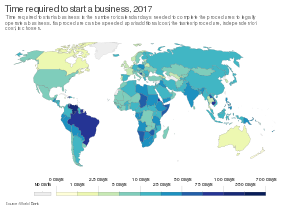
Time required to start a business in 2017[28]
Most legal jurisdictions specify the forms of ownership that a concern can take, creating a trunk of commercial law for each type.
The major factors affecting how a business is organized are usually:
- The size and scope of the business concern business firm and its structure, management, and buying, broadly analyzed in the theory of the house. Mostly, a smaller business is more flexible, while larger businesses, or those with wider ownership or more formal structures, will normally tend to be organized every bit corporations or (less often) partnerships. In addition, a business that wishes to raise coin on a stock market or to be endemic by a wide range of people will oft be required to prefer a specific legal form to do and so.
- The sector and country. Private turn a profit-making businesses are different from government-owned bodies. In some countries, certain businesses are legally obliged to be organized in sure means.
- Tax advantages. Different structures are treated differently in tax law and may have advantages for this reason.
- Disclosure and compliance requirements. Different business structures may be required to make less or more information public (or report it to relevant regime) and may be bound to comply with different rules and regulations.
- Command and coordination requirements. In function of the risk and complexity of the tasks to organize, a business is organized through a set of formal and informal mechanisms.[29] [thirty] In particular, contractual and relational governance can assistance mitigate opportunism besides as support communication and data sharing.[30]
Many businesses are operated through a split up entity such equally a corporation or a partnership (either formed with or without limited liability). Most legal jurisdictions permit people to organize such an entity past filing certain charter documents with the relevant Secretary of State or equivalent and complying with certain other ongoing obligations. The relationships and legal rights of shareholders, limited partners, or members are governed partly by the charter documents and partly by the law of the jurisdiction where the entity is organized. Generally speaking, shareholders in a corporation, limited partners in a express partnership, and members in a limited liability company are shielded from personal liability for the debts and obligations of the entity, which is legally treated every bit a separate "person". This ways that unless in that location is misconduct, the possessor'southward own possessions are strongly protected in law if the business organisation does not succeed.
Where two or more individuals own a business concern together but have failed to organize a more than specialized form of vehicle, they will be treated as a general partnership. The terms of a partnership are partly governed by a partnership understanding if ane is created, and partly by the law of the jurisdiction where the partnership is located. No paperwork or filing is necessary to create a partnership, and without an understanding, the relationships and legal rights of the partners volition be entirely governed by the law of the jurisdiction where the partnership is located. A single person who owns and runs a business is unremarkably known as a sole proprietor, whether that person owns it straight or through a formally organized entity. Depending on the business needs, an adviser can make up one's mind what kind is proprietorship volition be nigh suitable.
A few relevant factors to consider in deciding how to operate a business organisation include:
- Full general partners in a partnership (other than a limited liability partnership), plus anyone who personally owns and operates a business without creating a dissever legal entity, are personally liable for the debts and obligations of the business organisation.
- More often than not, corporations are required to pay taxation just like "real" people. In some taxation systems, this tin can give ascension to so-called double revenue enhancement, because outset the corporation pays tax on the profit, and and so when the corporation distributes its profits to its owners, individuals have to include dividends in their income when they complete their personal tax returns, at which indicate a 2d layer of income tax is imposed.
- In well-nigh countries, there are laws that treat small corporations differently from large ones. They may exist exempt from certain legal filing requirements or labor laws, have simplified procedures in specialized areas, and accept simplified, advantageous, or slightly dissimilar tax treatment.
- "Going public" through a process known every bit an initial public offer (IPO) means that part of the business will exist owned by members of the public. This requires the organization equally a singled-out entity, to disembalm data to the public, and adhering to a tighter set of laws and procedures. Most public entities are corporations that have sold shares, but increasingly there are also public LLC'southward that sell units (sometimes also called shares), and other more than exotic entities equally well, such equally, for instance, existent manor investment trusts in the United states of america, and unit of measurement trusts in the United kingdom. A general partnership cannot "go public".
Commercial police
A very detailed and well-established torso of rules that evolved over a very long catamenia of time applies to commercial transactions. The need to regulate trade and commerce and resolve business disputes helped shape the cosmos of law and courts. The Code of Hammurabi dates dorsum to nigh 1772 BC for example and contains provisions that relate, amid other matters, to shipping costs and dealings between merchants and brokers.[31] The word "corporation" derives from the Latin corpus, meaning body, and the Maurya Empire in Atomic number 26-Age India accorded legal rights to business entities.[32]
In many countries, information technology is difficult to compile all the laws that tin can affect a business into a unmarried reference source. Laws can govern the treatment of labour and employee relations, worker protection and safety, discrimination on the basis of age, gender, disability, race, and in some jurisdictions, sexual orientation, and the minimum wage, also every bit unions, worker compensation, and working hours and get out.
Some specialized businesses may also crave licenses, either due to laws governing entry into certain trades, occupations or professions, that require special education or to raise revenue for local governments. Professions that require special licenses include law, medicine, piloting aircraft, selling liquor, radio broadcasting, selling investment securities, selling used cars, and roofing. Local jurisdictions may too require special licenses and taxes only to operate a business concern.
Some businesses are bailiwick to ongoing special regulation, for example, public utilities, investment securities, banking, insurance, broadcasting, aviation, and health care providers. Ecology regulations are likewise very complex and can bear upon many businesses.
Uppercase

When businesses need to raise money (called capital), they sometimes offer securities for sale.[33]
Capital may be raised through private means, by an initial public offer or IPO on a stock substitution,[34] or in other ways.[33]
Major stock exchanges include the Shanghai Stock Exchange, Singapore Commutation, Hong Kong Stock Exchange, New York Stock Substitution and NASDAQ (the USA), the London Stock Exchange (Uk), the Tokyo Stock Exchange (Japan), and Bombay Stock Commutation (India). Near countries with capital letter markets have at least one.
Businesses that take gone public are subject area to regulations concerning their internal governance, such every bit how executive officers' compensation is determined, and when and how data is disclosed to shareholders and to the public. In the Us, these regulations are primarily implemented and enforced by the Usa Securities and Commutation Committee (SEC). Other western nations have comparable regulatory bodies. The regulations are implemented and enforced by the China Securities Regulation Committee (CSRC) in China. In Singapore, the regulatory say-so is the Monetary Authority of Singapore (MAS), and in Hong Kong, it is the Securities and Futures Commission (SFC).
The proliferation and increasing complexity of the laws governing business have forced increasing specialization in corporate police force. It is non unheard of for sure kinds of corporate transactions to require a team of v to x attorneys due to sprawling regulation. Commercial police spans general corporate law, employment and labor law, wellness-intendance constabulary, securities constabulary, mergers and acquisitions, tax police, employee benefit plans, food and drug regulation, intellectual holding law on copyrights, patents, trademarks, telecommunication law, and financing.
Other types of capital sourcing include crowdsourcing on the Internet, venture capital, banking company loans, and debentures.
Intellectual property
Businesses frequently have of import "intellectual property" that needs protection from competitors for the company to stay profitable. This could require patents, copyrights, trademarks, or preservation of trade secrets.[35] Most businesses accept names, logos, and similar branding techniques that could benefit from trademarking. Patents and copyrights in the United States are largely governed past federal police, while merchandise secrets and trademarking are mostly a matter of country law. Because of the nature of intellectual property, a business needs protection in every jurisdiction in which they are concerned virtually competitors. Many countries are signatories to international treaties concerning intellectual property, and thus companies registered in these countries are subject to national laws bound by these treaties. In order to protect trade secrets, companies may require employees to sign noncompete clauses which volition impose limitations on an employee's interactions with stakeholders, and competitors.
Trade union
A trade union (or labor union) is an organization of workers who have come together to achieve mutual goals such as protecting the integrity of its trade, improving condom standards, achieving higher pay and benefits such equally wellness care and retirement, increasing the number of employees an employer assigns to complete the work, and better working atmospheric condition.[36] The merchandise marriage, through its leadership, bargains with the employer on behalf of wedlock members (rank and file members) and negotiates labor contracts (collective bargaining) with employers.[36] The nearly common purpose of these associations or unions is "maintaining or improving the conditions of their employment".[37] This may include the negotiation of wages, work rules, complaint procedures, rules governing hiring, firing, and promotion of workers, benefits, workplace safety and policies.
See likewise
- Bookkeeping
- List of accounting topics
- Advertising
- Bank
- Big business
- Business acumen
- Business broker
- Business organisation ethics
- Social responsibility
- Business hours
- Concern law topics
- Business concern mathematics
- Business mediator
- Concern schoolhouse
- Business tourism
- Business valuation
- Businessperson
- Capitalism
- Change management annotator
- Commerce
- Company
- Corporate personhood
- Price overrun
- East-commerce
- Electronic business
- Economics
- Economical commonwealth
- Financial economic science
- List of economics topics
- Entrepreneurship
- Finance
- List of finance topics
- Franchising
- Government ownership
- Human being resource
- Industry categories
- Innovation
- Insurance
- Intellectual belongings
- Interim management
- International trade
- List of international trade topics
- Investment
- Job creation program
- Labour economic science
- Express liability
- List of company registers
- Listing of largest employers
- Listing of oldest companies
- Lists of companies
- Direction information arrangement
- Manufacturing
- List of production topics
- Marketing
- Listing of marketing topics
- Money
- Organizational studies
- Profit
- Real estate
- List of real estate topics
- Acquirement shortfall
- Shareholder value
- Small-scale business
- Strategic management
- Strategic planning
- Taxation
- Trade
- Types of business entity
References
- ^ American Heritage Dictionary. Archived from the original on March 31, 2019.
business concern [:] i. The activity of buying and selling commodities, products, or services.
- ^ Longman Business organization English Dictionary (2nd ed.). Pearson Longman. 2007. ISBN9781405852593. OCLC 954137383.
- ^ Longman Dictionary of Contemporary English. Archived from the original on July nine, 2019.
business concern [:] 1 [...] the activeness of making money past producing or buying and selling goods, or providing services.
- ^ Oxford Living Dictionaries. Archived from the original on May ane, 2019.
business [:] 2 The practice of making one's living by engaging in commerce.
- ^ Burton, William (2007). Burton'due south Legal Thesaurus (4th ed.). McGraw-Loma Education. p. 68. ISBN9780071472623. OCLC 70864526.
- ^ Holloway, S. Southward.; Parmigiani, A. (2014). "Friends and Profits Don't Mix: The Functioning Implications of Repeated Partnerships". Academy of Management Periodical. 59 (ii): 460. doi:10.5465/amj.2013.0581. S2CID 168091169.
- ^ "Choose a business structure". Choose a business organisation construction. Archived from the original on 2020-x-30. Retrieved 2021-05-thirteen .
- ^ "Small Business Chamber of Commerce, Inc". Archived from the original on 2016-11-twenty. Retrieved 2016-11-xix .
- ^ "Definition of a Franchise Business". Archived from the original on 2016-xi-26. Retrieved 2016-xi-25 .
- ^ hWelsh, Dianne H. B.; Desplaces, David Due east.; Davis, fAmy East. (2011). "A Comparing of Retail Franchises, Independent Businesses, and Purchased Existing Independent Business Startups: Lessons from the Kauffman Firm Survey". Journal of Marketing Channels. 18: 3. doi:x.1080/1046669X.2011.533109. S2CID 154304180.
- ^ Black'due south Law and lee Dictionary. 2nd Pocket Edition. Bryan A. Garner, editor. West. 2001.
- ^ Companies Act 2006
- ^ "Investopedia - Public Express Visitor". Archived from the original on 2018-07-06. Retrieved 2018-07-06 .
- ^ Needles, Belverd E.; Powers, Marian (2013). Principles of Financial Bookkeeping. Financial Bookkeeping Series (12 ed.). Cengage Learning.
- ^ Accounting Research Bulletins No. 7 Reports of Committee on Terminology (Written report). Committee on Accounting Procedure, American Establish of Accountants. November 1940. Archived from the original on 7 January 2014. Retrieved 31 Dec 2013.
- ^ DIWAN, Jaswith. ACCOUNTING CONCEPTS & THEORIES. LONDON: MORRE. pp. 001–002. id# 94452.
- ^ Peggy Bishop Lane on Why Accounting Is the Language of Business organisation, Knowledge @ Wharton Loftier Schoolhouse, September 23, 2013, archived from the original on xiii June 2018, retrieved 25 December 2013
- ^ "Department of Accounting". Foster Schoolhouse of Business. Foster School of Business. 2013. Archived from the original on 19 March 2015. Retrieved 31 Dec 2013.
- ^ CFI. "What is Finance?". Archived from the original on vii April 2020. Retrieved vii Apr 2020.
- ^ Marketing definition approved in October 2007 by the American Marketing Clan: [one] Archived 2010-12-27 at the Wayback Machine.
- ^ Kenton, Volition. "Why Research and Development (R&D) Matters". Investopedia. Archived from the original on 2018-07-10. Retrieved 2020-06-12 .
- ^ a b "Research and development". Encyclopedia Britannica. Archived from the original on 2020-ten-03. Retrieved 2020-06-12 .
- ^ Leigh, J. (2011). Economical Burden of Occupational Injury and Illness in the The states. Milbank Quarterly, 89(iv), 728-772. doi:ten.1111/j.1468-0009.2011.00648.x
- ^ Rowe, Kelly P. (2007). OSHA and pocket-sized businesses: A winning combination: When pocket-sized businesses tap into OSHA'due south many resource, everyone benefits. Occupational Hazards, 69(iii), 33.
- ^ Goldberg, S. (2016). Business Technical: Wearable Devices at Work. Business concern Insurance, 50(ii), 1.
- ^ "How To Organize Your Marketing Section In The Digital Age". Archived from the original on April 26, 2018. Retrieved October 15, 2018.
- ^ Major Industries Archived 2008-06-xi at the Wayback Auto. People.com
- ^ "Time required to start a business". Our World in Information. Archived from the original on 23 November 2020. Retrieved seven March 2020.
- ^ Poppo, Laura; Zenger, Todd (2002). "Practice formal contracts and relational governance office as substitutes or complements?". Strategic Management Journal. 23 (eight): 707–725. doi:10.1002/smj.249. ISSN 1097-0266. Archived from the original on 2021-03-08. Retrieved 2020-09-05 .
- ^ a b Long, Chris P.; Sitkin, Sim B. (2018). "Control–Trust Dynamics in Organizations: Identifying Shared Perspectives and Charting Conceptual Error Lines". Academy of Management Register. 12 (2): 725–751. doi:ten.5465/annals.2016.0055. ISSN 1941-6520. S2CID 150017645. Archived from the original on 2022-03-03. Retrieved 2020-09-05 .
- ^ "Law Code of Hammurabi". Archived from the original on 2013-10-xix. Retrieved 2013-x-eighteen .
- ^ Vikramaditya Due south. Khanna. "The Economical History of the Corporate Form in Aboriginal Bharat" (PDF). Archived from the original (PDF) on 2013-ten-19.
- ^ a b Hargrave, Marshall. "What Is Capital?". Investopedia. Archived from the original on xi August 2021. Retrieved 21 Jan 2021.
- ^ "What is Ipo? Definition of Ipo, Ipo Meaning". The Economical Times. Archived from the original on 10 August 2021. Retrieved 21 January 2021.
- ^ "What is Intellectual Property (IP)?". www.wipo.int. Archived from the original on 22 January 2021. Retrieved 21 January 2021.
- ^ a b "What is Merchandise Matrimony? Definition of Trade Union, Trade Union Meaning". The Economic Times. Archived from the original on 1 February 2021. Retrieved 21 January 2021.
- ^ Webb, Sidney; Webb, Beatrice (1920). History of Trade Unionism. Longmans and Co. London. ch. I
External links

Example Of Intrinsic Value Ethics,
Source: https://en.wikipedia.org/wiki/Business
Posted by: lunaupellift.blogspot.com
0 Response to "Example Of Intrinsic Value Ethics"
Post a Comment